


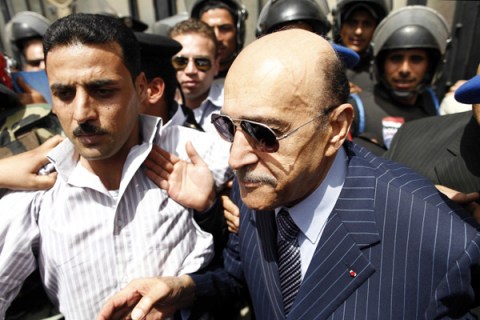
Former Egyptian intelligence chief Omar Suleiman enters the election-committee building in Cairo on April 7, 2012 to register his name for the presidential election
The Egyptian public knew very little about Omar Suleiman. But the former spy chief had remained a symbol of Hosni Mubarak’s regime long after the 2011 popular uprising that forced Mubarak from power. His brief presidential candidacy last spring was jeered and protested. He had served as the head of Egypt’s elusive General Intelligence Service — or the mukhabarat — for two decades. Rights groups say he presided over a system in which arbitrary detention and torture were commonplace; he was Washington’s liaison for the rendition of terrorist suspects. He was Mubarak’s right-hand man, trusted with the most sensitive security files and political missions. And he will forever be the one that got away.
For 13 days in 2011, as Mubarak struggled to hold onto power in the face of a protest movement that wouldn’t back down, Suleiman assumed for protesters the face of the enemy. He was the dictator’s last minute Vice President, a presumed safety valve that failed. In the aftermath of the regime’s fall, some called for his head. “Suleiman’s papers should not have been submitted to the elections commission, but to the courts,” Mohammed el-Beltagy, a prominent member of the Muslim Brotherhood, said recently in an interview on the privately owned ONTV station. “[Suleiman’s agency] is at the heart of Mubarak’s regime, which used to rely on the intelligence services and state security.”
(MORE: Egypt: The Presidential Candidate Who Came in from the Cold)
But no one ever really went after Suleiman in the wake of Mubarak’s fall from power last February. And 18 months into a rocky, democratic transition, he never lost his ability to inspire respect, anger and — especially — fear. Indeed, when Suleiman died late Wednesday night in a hospital in Cleveland, at the age of 76, he did so quietly and as a free man. Suleiman was one of the few high-ranking members of Mubarak’s regime to escape prosecution — or even an investigation — in the aftermath of the dictator’s fall. The local press reported on a handful of civil suits that lawyers filed against Suleiman in the months following Mubarak’s ouster, but all mysteriously disappeared after they were handed to military courts. He was a “black box” of regime secrets, some analysts argued — too knowledgeable to prosecute and bring into the light.
Suleiman went on living a shadowy existence in the villa he kept next door to Mubarak’s in the upscale Cairo neighborhood of Heliopolis. And just as they had known so little about the spy chief’s life and actions, few Egyptians foresaw his death. Few outside his inner circle knew that Suleiman had suffered from a worsening heart condition in recent months or that, according to a former colleague, General Sameh Seif al-Yazal, he had a brain tumor removed a few years ago. Even as the now-imprisoned Mubarak’s own health crises have topped the nation’s headlines in recent months, the life and times of Suleiman have remained shrouded in mystery.
Suleiman was born in southern Egypt in 1936 and rose through the ranks of the Egyptian military to become the head of military intelligence before Mubarak made him chief of Egypt’s spy agency in 1991, during the Gulf War. As head of the mukhabarat, Suleiman oversaw a close strategic relationship with Israel, negotiations between Palestinian factions and the surveillance of opposition activists at home. He ran operations to extradite Egyptian terrorist suspects living abroad, some of whom returned to torture and lengthy prison sentences without trial. “Before the revolution, he was involved in many files. He was very much trusted by Mubarak, and he was given many missions — political missions and as a personal envoy to many countries,” says al-Yazal. During the revolution, “he was running the show.”
Suleiman leaves behind a wife, three daughters and the legacy of a feared intelligence agency, which — by all accounts — remains fully operational and more shadowy than ever, 1½ years after Mubarak’s downfall and three weeks after the election of a new President. Suleiman’s replacement is Mourad Mwafi, another former military-intelligence chief who, in a 2010 interview with TIME, claimed close ties with his Israeli counterparts and defended Egypt’s “right” to extraordinary measures to protect itself from terrorism.
There’s no telling how well he’ll work with Egypt’s first democratically elected President, Mohamed Morsy, who hails from Suleiman’s and Mubarak’s longtime foe, the Muslim Brotherhood. But Morsy, who has seen his powers already limited by the powerful military generals that Mubarak left behind, is unlikely to have much authority over the most guarded of the country’s security agencies. Technically, he could appoint a new spy chief, says Fouad Allam, a former head of state security. “But there’s no point. Even if he did assign a new head of intelligence, that person would have to be from intelligence,” he says. “You can’t ask an engineer to conduct surgery, and I can’t ask a surgeon to build a house.” Suleiman may be gone, but his legacy will be far more difficult to erase.