


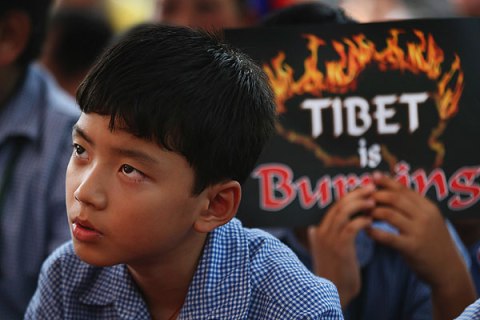
A Tibetan exile participates in a Flame of Truth march in New Delhi, India, Monday, Oct. 15, 2012.
Late last month, more than four hundred Tibetans met in Dharamsala, the northern Indian hill town that hosts the Tibetan government-in-exile. Before a portrait of the Dalai Lama, they sang the Tibetan National Anthem and remembered Tibetans who died protesting Chinese rule. And while the Dalai Lama himself remained absent from the meeting, having given up his political powers last year, he casts a long shadow.
Ever since he fled to India in 1959 after an unsuccessful uprising against Beijing, the question of Tibet — and exiled Tibetans — has loomed large over India-China ties. While India provided shelter to the Dalai and his followers, they have no political rights in the country and live as refugees with a stay permit despite the fact that the Indian state doesn’t officially recognize refugees. This generosity, as India clarifies often, was out of respect for the Dalai Lama and his spiritual eminence.
(PHOTOS: Tibetans Protest Hu Jintao in India)
Many in China, however, deem this as meddling in its internal affairs. As early as in May 1959, Mao Zedong, a top Chinese leader, in his “The Revolution in Tibet and Nehru’s Philosophy” had accused Nehru of encouraging Tibetan rebels. And as recent as last year, Chinese foreign ministry spokesperson, Hong Lei had said China opposes “any country that provided a platform to the Dalai Lama” whom they consider a separatist. Last year, China also canceled border talks with India in protest over a speech by the Dalai Lama in New Delhi. That may be a rote, predictable gesture at this point, but it speaks of an intractable problem dogging ties between the two Asian giants. “The issue of Tibet is a core issue between India and China,” Lobsang Sangay, the prime minister of the Tibetan government-in-exile, told TIME. “We want India to have productive relations with all its neighbors including China.”
That sentiment carries special resonance now as the two countries mark on Oct. 20 the 50th anniversary of the Sino-Indian border war of 1962. The month long war, which was won decisively by the Chinese, was a bitter, humiliating blow for the Indians, whose meager defenses were woefully unprepared for the rapid advance of Beijing’s forces. The conflict saw Chinese soldiers attacking across the disputed McMahon line, a boundary drawn through the Himalayas and its rugged, sparsely populated foothills in 1914 by British colonial authorities and Tibetan officials—thus a border which Beijing refuses to recognize. China’s desire to secure its hold over Tibet played a significant role in its decision to raid into India; Beijing unilaterally declared a ceasefire Nov. 21, 1962 and withdrew from much of the land it conquered save the strategic barren territory appended to Kashmir known as Aksai Chin.
(MORE: As Tibetans Mark ‘National Uprising Day,’ Tensions Simmer on the High Plateau)
While the dispute remains frozen over glacial passes and rounds of border talks yield pitiful results, the narrative of India-China ties has moved on. The last ten years have been shaped by growing, significant economic links. In 2005, the two countries agreed to a “strategic and cooperative partnership” after a meeting between Chinese premier Wen Jiabao and Indian PM Manmohan Singh. Last June, Chinese vice premier Li Keqiang proclaimed Sino-Indian ties to be the most important bilateral relationship in the 21st century. “India and China are not in competition,” Singh said in 2009. “There is enough economic space for us both.”
But where does Tibet fit into this picture? China’s annoyance at India sheltering the Dalai Lama has surfaced regularly, and India has often made concessions to its trade partner’s sensitivities. In 2009, Beijing raised a stink when the Dalai Lama wanted to visit Tawang, a historic monastery town in Arunachal Pradesh—a state the Chinese still claim as “Southern Tibet.” While New Delhi didn’t stop him, it restricted coverage of the event by not allowing foreign journalists to accompany him to the country’s remote Northeast. In 2011, the Chinese consulate in the eastern Indian city of Kolkata sent a written protest when the governor of West Bengal met the Dalai Lama while he was in the city on a speaking tour, ruffling feathers in India. “They have no business doing that publicly,” Sangay says referring to the written protest. “That’s interference in India’s sovereignty and internal matters.”
(SPECIAL: China’s Century — or India’s?)
China disagrees. According to Beijing, the Dalai is a terrorist with a separatist agenda. “I do not think that China’s protest against the Dalai’s movements for ‘Tibet Independence’ in India is interference in India’s internal matters, but just on the opposite that if India allows Dalai to engage separatist activities in India is interference in China’s internal affairs,” Wang Dehua, Director of the Shanghai-based South Asia Research Center at Tongji University told TIME. “The so-called autonomy of Tibet, [that] the Dalai Lama claims to be seeking is actually the independence of Tibet, which is definitely forbidden.”
Predictably, despite recent visits from high profile Chinese dignitaries, including President Hu Jintao and defense minister General Liang Guanglie, the issue of Tibet continues to be a point of tension. According to observers China still fears that India will leverage the might of its more than 100,000 Tibetan exiles on its soil and fuel tension in Tibet. “The Tibet issue is one of China’s historical fears,” says C. Uday Bhaskar, former director of the New Delhi based think tank, the Institute for Defence Studies and Analyses. “But India has never used the Tibet card”—in a fragile geo-political neighborhood, New Delhi knows better than to use its small leverage in a contest it can’t win.
Given the political and economic stakes, both sides are likely to grudgingly preserve the status quo, at least for now. “There is a certain trend of animosity [in China] towards India, which is continuous,” Mohan Guruswamy of the Observer Research Foundation says. “And we have to live with that just the way they have to live with our growing friendship with other countries and the Tibet issue. 1962, however, will never happen again.”
PHOTOS: Funeral of an Exiled Tibetan Activist