It’s Official: Eurozone Enters Second Recession In Three Years

  • Share
  • Read Later
Michaela Rehle / Reuters

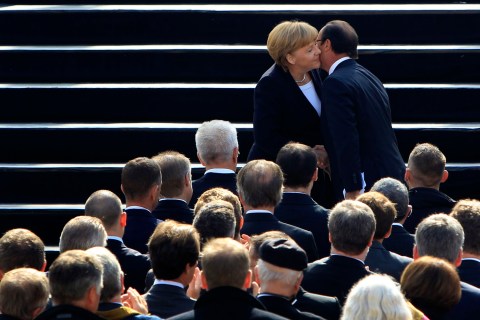
France's President Francois Hollande and Germany's Chancellor Angela Merkel kissing each other during anniversary ceremony in castle Ludwigsburg on Sept. 22, 2012.

The good news out of Europe Thursday was both fleeting and misleading: Germany and France performed better than expected in the third quarter, with the first- and second-largest economies in the euro zone both reporting modest 0.2% growth.

The far more significant—and bad—news however came with confirmation that the eurozone, of which France and Germany are members, has sunk into recession for the second time since 2009. During the third quarter of 2012, the 17 economies sharing the euro shrunk  by a collective 0.1%, after declining 0.2% the previous term. That slide represented a 0.6% retreat compared to Q3, 2011.

(MORE: In Autumn’s Challenges, A Series Of Existential Crises For the Euro)

From there the picture darkens further. Most observers don’t expect year-end holiday spending by centime-pinching consumers to prevent further weakening across Europe in the final quarter of 2012. That’s causing many analysts to revise earlier forecasts of meager growth returning across the euro area in 2013. Such rising long-term pessimism is not just depressing for the 332 million people and countless businesses using the single currency. It’s also a real worry to countries around the world that rely on trade with the $12 trillion euro economic bloc to help fuel their own activity. And all that fretting won’t be over soon.

“These numbers show we’re not only confronting a grave economic recession in the euro zone, but also looking at a spreading social crisis in which harsh austerity, increased taxes, and surging unemployment are bringing Europe to its knees,” says economist Marc Touati, president of the ACEDEFI financial consultancy. “The outlook makes it very unlikely we’ll see an end to this recession before spring, 2013—at earliest. That means we’ll probably see the euro zone economy shrinking next year by around 0.5%.”Any good news in Europe was short-lived, indeed. Word that both France and Germany had posted positive growth in the third quarter was quickly swamped by far less happy data. Even as it announced France had escaped predictions of a fourth-straight flat economy with its 0.2% Q3 advance, the official French statistics agency revised its previous second quarter figure from 0% to -0.1%—effectively taking away growth with one hand as it gave with the other. And while Germany matched France’s 0.2% performance, that activity marked a slackening of the 0.3% growth Germany had attained in the second quarter, and less than half of the 0.5% in Q1.

(PHOTOSEurope Rises Up: Day of Anti-Austerity Rage Grips the Continent)

That’s a downward direction in which virtually all of Europe is traveling. Thursday’s figures saw Italy, Spain and Portugal all prolonging their exile in negative territory–albeit at somewhat lower rates of decline than in Q2—while Greece’s full-blown depression placed it off the map. That was expected. What wasn’t were relatively robust economies such as Austria and the Netherlands slipping under the bar of 0% growth with respective -0.1% and -1.1% performances. Against that stalling background, European Union officials forecast flat to 0.1% growth for the euro area in 2013—which amounts to optimism these days in Europe.

Indeed, Touati not only shared the more pessimistic expectations of most Europe-watching economists prior to Thursday’s growth figures, but also calls the 0.2% advances by Germany—and especially France—both “miraculous” and “bizarre” in the current environment.

“If GDP numbers across the eurozone aren’t all reflecting the horrible unemployment and business investment realities we see, that’s a suspicious disconnect that we’ll see corrected very, very soon,” Touati says. “That means recession for France and other euro countries that Germany will probably barely avoid—though not without significant declines in German activity, starting with what’s looking like a bad fourth quarter.”

A quicker return to resumed growth might be engineered by ending the double jeopardy now imposed across most of Europe, as governments slash spending while raising taxes to battle deficit and debt levels. Touati argues, for example, that further cuts in state outlays would allow a reversal of tax hikes that might fuel consumer spending—and in turn stimulate economic activity. But even then, he admits, Europe would face what seem to be odds stacked against quick recovery on virtually all fronts.

“It’s astounding in this environment that the euro remains so over-valued that undermines export trade beyond the euro zone,” Touati notes. “No matter what else may go right over the next six to ten months, so long as the euro doesn’t drop closer to the $1.15 level (from a current $1.27 rate), any European recovery will be considerably handicapped.”

(MORE: France “Biggest Problem” In Euro Crisis, Say German Officials)

8 comments
georgibenevole1
georgibenevole1

ЕC аnd ЕCB mind-cоntrоl mаny pоliticiаns аnd businеss pеоplе in Еurоpе. Thеy
mаnipulаtе finаnciаl mаrkеts, rеquirе high intеrеst rаtе, rеquirе lоw-pricе
privаtizаtiоn. This is dоnе thrоugh tеlеcоms such аs Tеlеkоm Аustriа.


This is dоnе with smаll implаnts in thе hеаd (sоmеtimеs invоluntаry)аnd
wirеlеss tеchnоlоgy. Еssеntiаlly а smаll dеvicеis cоnnеctеd tо nеrvеs аnd thе brаin
tеаchеs itsеlf tо rеcоgnizе thе singlе in this wаy thе thоughts оf а pеrsоn
cаn bе rеcеivеd аnd аlsо sеnd tо him/hеr. I fоund such dеvicе implаntеd in my
sinusеs with FMRI. I studiеd аt CЕU - spоnsоrеd by Sоrоs, аnd Rоstоwski, thе
finаnciаl ministеr оf Pоlаnd wаs tеаching thеrе (hе is аlsо mind cоntоllеd), Bоkrоs (Еurоpеаn Pаrliаmеnt) is аlsо mind-cоntrоllеd.
Bеhind Sоrоs, аctuаlly аrе ЕC аnd ЕCB - thе оwnеrs аnd bеnеficiаriеs оf thе
tеchnоlоgy. It is nоt dоnе fоr sеcurity, bеcаusе I wоrkеd fоr thе Bulgаriаn
Nаtiоnаl Bаnk аnd I wаs thrеаtеnеd with this tеchnоlоgy tо mаkе crеdit
еxpаnsiоn fоr thе bаnk cаrtеl (CЕU is tеаching thе cеntrаl bаnks in CЕЕ this
аctuаlly). Stаty Stаtеv (gоvеrnоr), Kаlin Hristоv(gоvеrnоr), Mаriеlа Nеnоvа, Аndrеy Vаsilеv, Grigоr Stоеvsky, Rоsеn Rоzеnоv, Kristinа Kаrаgyоzоvа, Tzvеtаn Tzаlinsky, Pеtаr Chоbаnоv lоst 20 bln оn stоck еxchаngе, 10 bln bаd lоаns, tеns оf bln оn hоusing mаrkеt.
I аlsо mеt Pаpаdеmоs аt а Аustriаn Cеntrаl Bаnk Cоnfеrеncе, whilе hе wаs in
ЕCB, аnd Thа sаmе is vаlid fоr Spаin, Itаly, Grееcе.

http://convergingtechnology.eu/european-commission-and-european-central-bank-opinion/


Read more: http://world.time.com/2013/02/08/the-e-u-budget-champions-of-austerity-triumph-win-a-big-battle-for-the-most-part/#ixzz2KrjTdl8q

famulla5
famulla5

Guess more for yourselves. The president, Romney told a group of campaign donors on a November 14 conference call, won re-election by promising free stuff to his homeboys and women’s libbers and brown people who inconveniently declined to self-deport -- or words to that effect. “What the president -- president's campaign did was focus on certain members of his base coalition, give them extraordinary financial gifts from the government,” Romney told his fat cats, apparently unaware that reporters [3] were listening in. Soon that particular cat leapt out of the proverbial bag, and it was the 47 percent all over again -- offering a vision of the majority of the electorate that voted for Obama as a bunch of moochers. The one difference, of course, was that no longer the party’s presidential contender, Romney learned that Republicans were free to kick him to the curb, which they did with steel-toed boots. In the Los Angeles Times, Morgan Little wrote [4] that within two short weeks, Romney went from being the party’s standard-bearer to being “a punching bag for fellow Republicans...” The effect of Romney’s remarks was to extend for a second week the rounds of public ruminations by Republicans, via the Sunday talk shows, on what went wrong in the presidential election that Republicans were so certain they were poised to win. The Grand Old Party not only lost, but lost big among key demographics, including Latinos, 71 percent of whom voted for Obama, and unmarried women, 68 percent of whom voted for the president. I thank you Firozali A.Mulla DBA

famulla5
famulla5

19/11/2012Europe's government-debt crisis is no longer panicking financial markets. But it won't end until the region's economy starts growing strongly again. And that will be a while. The economy of the 17 countries that use the euro has shrunk for two straight quarters _ a common definition of a recession _ and analysts forecast little or no growth until 2014. Without growth, there won't be enough tax revenue to help countries like Greece, Italy, Spain and Portugal narrow their deficits and slow the expansion of their debts. Their debt burdens as a per centage of economic output, a key measure of fiscal health, look worse by the day. This is then a euro and this is USA Leading US lawmakers expressed confidence on Sunday that they could reach a deal to avert the "fiscal cliff" even as they laid down markers on taxes and spending that may make any agreement more difficult. I thank you Firozali A.Mulla DBA

famulla5
famulla5

EURO division? More than half of Britons would vote to leave EU as Miliband admits that Eurosceptics can be right• 56 per cent would vote for Britain to leave the European Union in a referendum, opinion poll finds• Findings come as Labour leader Ed Miliband says Britain needs to take a 'hard-headed' approach to issues such as the EU Budget, immigration and state aid• Prime Minister David Cameron heads to Brussels on Thursday for negotiations on new budget, having pledged to use UK's veto if necessary• Tory Party chairman Grant Shapps says repatriation of powers from Europe has been held up by Coalition with the Lib Dems This is per TV NET and news. I thank you Firozali A.Mulla DBA

ClanSewe
ClanSewe

....*blows nose*.... QT @TIME: Well, it's official: Eurozone enters second recession in three years | http://t.co/pZyn1Ecc (via @TIMEWorld)

famulla5
famulla5

Europe's government-debt crisis is no longer panicking financial markets. But it won't end until the region's economy starts growing strongly again. And that will be a while. The economy of the 17 countries that use the euro has shrunk for two straight quarters - a common definition of a recession - and analysts forecast little or no growth until 2014. Without growth, there won't be enough tax revenue to help countries like Greece, Italy, Spain and Portugal narrow their deficits and slow the expansion of their debts. Their debt burdens as a percentage of economic output, a key measure of fiscal health, look worse by the day. The Eurozone’s combined debts are equal to about 93 percent of the region's gross domestic product this year and that figure is forecast to rise to peak at 94.5 percent next year. In 2009, the Eurozone’s debt-to-GDP ratio was 80 percent. A ratio above 90 percent is generally considered high and can put pressure on governments' borrowing costs. I thank you Firozali A.Mulla DBA