Is the E.U. Nearing a Landmark Banking Deal?

  • Share
  • Read Later
Virginia Mayo / AP

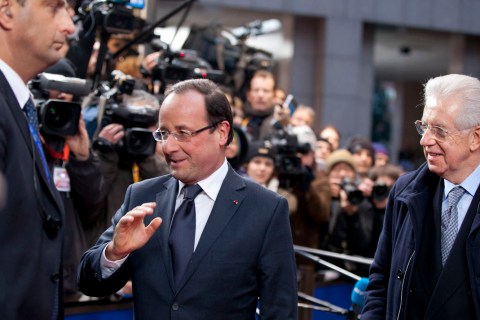
French President Francois Hollande, center, and Italian Prime Minister Mario Monti, right, arrive for an EU summit in Brussels on Dec. 13, 2012.

The crisis-battered euro zone got some rare cheer early Thursday with news that significant agreements had been made in creating a banking union across the European Union. Those unexpected advances by E.U. finance ministers towards establishing a Single Supervisory Mechanism (SSM) for the region will allow leaders of the 27-nation bloc meeting in Brussels Dec. 13-14 to hail another major step in getting Europe’s financial house in order.

Some officials didn’t bother waiting for EU heads to huddle as they cheered Thursday’s progress towards correcting the weaknesses that created the single currency’s crisis in the first place.

“This is an accord that creates unified bank supervision,” French Finance Minister Pierre Moscovici told reporters early Thursday, following all-night negotiations with his peers. “Little by little, we’re resolving the crisis in the euro zone. It’s a signal to the rest of the world: you can have confidence in the euro.”

(MORE: What Mario Monti’s Exit Tells Us About Europe’s Debt Crisis)

Though thorny details remain to be thrashed out, Thursday’s breakthrough was a pleasant surprise in light of the clashing positions various EU members—notably France, Germany, and the U.K.—had previously staked out. Just as amazing, equal measures of compromise appear to have been made all around. The result was a considerable bound towards a final accord granting the European Central Bank (ECB) the supervisory and backstop role for all EU banks whose assets surpass $39 billion, or represent 20% of their home nation GDP. Barring any changes, around 200 of Europe’s big banks would come under unified supervision, which will cover up to 85% of banking sectors in highly consolidated markets like France.

The SSM aims to create centralized oversight to prevent the kinds of lending and investment excesses by banks that occurred under national regulation—and transformed Europe’s sovereign debt problem into the full-blown euro crisis. The initiative will also allow the ECB to provide bail-out money directly to faltering banks, rather than forcing dangerously over-indebted national governments to continue assuming responsibility for those loans. If need be, meanwhile, the ECB will also be able to pronounce and organize the orderly closure of banks thought to be beyond salvaging.

(MORE: Bailouts and Austerity Measures Aren’t Working: Is This the Euro’s Last Stand?)

In other words, two main concerns of markets, economists, and leading euro nations about the single currency’s future are being addressed in the agreement: monetary union is being matched by increased convergence of fiscal policy and regulation; and gaps that had allowed excessive spending by banks and governments alike before the crisis are now being closed.

“We have reached the main points to establish a European banking supervisor that should take on its work in 2014,” declared German Finance Minister Wolfgang Schaeuble Thursday. His boss, Chancellor Angela Merkel, agreed, saying the advance “cannot be praised too highly.”

But if the previously clashing partners seemed to have all bent towards one another to create the breakthrough, problems with the looming union still remain.

For example, Germany successfully resisted French insistence the ECB have supervision of all Europe’s 6,000-odd banks, and succeeded in keeping smaller ones under control of national regulators. But deal will still accord the ECB  power to audit and restructure any bank it decides to regardless of size–somewhat mooting German victory on the matter. And Berlin isn’t happier about that than it is with the potential conflict of interest between the ECB’s primary mission—fighting inflation through monetary policy—and its additional mandate of tending to the health of (and at times extending loans to) Europe’s banking sector.

(MORE: Why the Euro Crisis Is Nowhere Near Being Over)

Membership of the new union is also a sack of nails. All 17 euro-member countries will partake in the SSM, as will those that have not adopted the single currency but wish to place their banks under centralized supervision. Britain, Sweden and the Czech Republic—none of which use the euro—have said they’ll remain outside the banking union. Denmark—the only other EU nation besides Britain with a formal opt-out clause for adopting the euro one day—says it may join the SSM all the same.

Moreover, London demanded concessions on voting procedures that would have permitted it to oppose any new regulations or taxes approved by a euro zone majority, but which the UK felt would penalize the City as Europe’s financial center. Though Thursday’s agreements don’t grant the UK outright veto mechanism it sought, UK chancellor of the Exchequer George Osborne said agreements were made to ensure “countries that weren’t going to join the banking union, like Britain, were protected and their interests were protected”.

Yet despite Thursday’s advance by EU finance ministers, the banking union deal isn’t done just yet. Leaders have just three weeks to work through outstanding questions and finalize their deal before the Dec. 31 deadline they set for themselves expires. Chief among those may be exactly when the new European regulator will be up and fully functional.

Paris insists that happen by Jan. 1, 2014. Germany wants more time to be taken to assure the regulator is ready for effective operation and will hit the ground running. But not only for that reason. That delay would also help hedge against the SSM—and its bail-out function using, in considerable part, German taxpayer money—from becoming a troubling issue for Merkel in Germany’s October, 2013 general elections. But even that threat may be minimal to Merkel if continued integration of euro members achieves the goals behind that convergence: saving the single currency, surmounting the brutal crisis it has faced, and leaving the turmoil, fear, and financial waste of recent years forever behind.

(MORE: E.U. Summit: Up All Night, But Consensus Finally Reached)

19 comments
famulla5
famulla5

Speak so we hear and act but if no we have no idea

He did not utter the words, butPresident Obamasuffused his second Inaugural Address with the spirit of a favourite phrase: the Rev. Dr. Martin Luther King Jr.’s call to heed “the fierce urgency of now.”

This was a president unbound from much of what defined him upon taking office four years ago, a man clearly cognizant of time already running down on his opportunity to make his imprint on the country and on history.

Gone were the vision of a new kind of high-minded politics, the constraint of a future re-election campaign and the weight of unrealistic expectations. In their place was an unapologetic argument that modern liberalism was perfectly consistent with the spirit of the founders and a notice that, with no immediate crisis facing the nation, Mr Obama intended to use the full powers of his office for progressive values. “We must act, knowing that our work will be imperfect,” he said. After spending much of his first term “evolving” on the question ofsame-sex marriageand doing too little in the eyes of many African-Americans to address poverty and civil rights, he invoked “Seneca Falls and Selma and Stonewall” and cited responsibility for the poor, sick and displaced. He acknowledged the budget deficit but emphasized protectingMedicare,MedicaidandSocial Security. He mentioned jobs but highlighted global warming. He lauded the bravery and strength of the United States armed forces, but started his foreign policy remarks by asserting that “enduring security and lasting peace do not require perpetual war.” Mr Obama came to office four years ago all but consumed by what he inherited: two wars and an economy in free fall. He then confronted an exhausting series of crises and political problems at home and abroad: budget showdowns, a hugeoil spillin the Gulf of Mexico, Middle East turmoil, the rise of theTea Party movement. I thank you Firozali A.Mulla DBA

famulla5
famulla5

House Republicans are teeing up a vote this week on a new debt-ceiling bill, marking the first legislative battle of President Obama's second term and one that could determine whether the country once again risks default over a political fight. House leaders, after unveiling the legislation Monday, are planning to hold a vote Wednesday on their plan to allow the government to keep borrowing through May 18. While the short-term increase is getting mixed reviews, the second plank of the legislation -- meant to pressure Senate Democrats to pass a budget -- has also raised questions. Under the proposal, Congress would withhold the pay of lawmakers in either the House or the Senate if their chamber fails to pass a budget by April 15. House Republicans have passed budgets for two consecutive years, but the Senate hasn't passed one since Obama's first year in office. But the so-called "no budget, no pay" provision has run into complaints that it's not constitutional. Critics point to the 27th Amendment, which states: "No law, varying the compensation for the services of the Senators and Representatives, shall take effect, until an election of Representatives shall have intervened." Rep. Hakeem Jeffries, D-N.Y., said Monday "it appears that the 27th Amendment does not permit Congress to alter its pay in the midst of a current session." House Republican leadership is defending the plan. A GOP leadership aide told Fox News that members would ultimately get paid, since "constitutionally we have to pay members." The suggestion is that the plan would not violate the 27th Amendment because it would temporarily withhold pay, as opposed to reducing pay. Under the plan, members' pay would be put in escrow starting on April 15 for any chamber that hasn't passed a budget resolution. As for the debt ceiling provision, the legislation does not set a specific limit; rather it would automatically increase the limit by the amount required to fund U.S. government obligations through May 18. I thank you Firozali A.Mulla DBA


famulla5
famulla5

Barack Obama. Obama may be the perfect representative of our age, because he encapsulates our national schizophrenia over the budget. He honors both the greed and the guilt. He presided over the largest deficits in history, including a large fiscal stimulus, bailouts of the auto industry, and an expansion of the safety net.

But Obama also lectures us about the need for the government to tighten its belt, even during a recession. He wants to raise taxes, if only on a few, and he’s expressed willingness to cut into the great middle-class entitlements. It was Obama’s administration that first suggested the bargain in 2011 that created the fiscal cliff. I thank you Firozali A.Mulla DBA

famulla5
famulla5

Theeuro zonecrisis is entering a new, treacherous phase for governments, which can only cross their fingers that slow-burn reforms will pay off before voters get fed up with austerity and high unemployment. On the face of it, 2013 should be a much less traumatic year than 2012 for the 17-nation single-currency area. Financial conditions have improved enormously since the European Central Bank promised to do whatever it takes to preserve the euro. Yields on the bonds of highly indebted peripheral countries have fallen sharply, bank-funding strains have eased and stockmarketshave rallied. Countries on the southern rim of the euro zone have made big strides in reducing their budget and trade deficits. They are no longer living way beyond their means. They have also introduced politically touchy structural reforms, notably to make their labourmarketsmore flexible But demand is likely to remain weak, while unemployment, already at a record 11.8 percent, is forecast to rise further before it comes down. Recovery will be slow. I thank you Firozali A.Mulla DBA

famulla5
famulla5

Europe's emerging east especially is expected to benefit if the zone debt crisis continues to ease, after inflows to the region slowed last year, the Institute of International Finance said in a report. The leading rich economies have kept interest rates at historic lows and are taking action to ease policy even further, with Japan announcing unlimited asset buying - essentially, printing more money - on Tuesday. Investors' search for yield helped push emerging market debt issuance to record highs last year - 30 percent above the previous year's total, itself a record Huge flows into emerging markets have caused problems in the past, strengthening currencies in developing countries that are heavily reliant on exports and prompting fears of currency wars. A chorus of policymaker voices have warned of this threat, including the heads of the British and German central banks. IIF Managing Director Charles Dallara echoed those comments on Tuesday, saying lack of economic policy coordination among key countries and economies was a serious concern. "We seem to have been experiencing a very steady process, for the last four years at least, of weakening policy integration and I think it poses a real risk for the global economy," he told a media conference in Zurich “Markets do react harshly and with volatility to indications of global policymakers failing to work together, and it can exacerbate the process of trying to undergo risk-adjustment." I thank you Firozali A.Mulla DBA


famulla5
famulla5

Virgin lets 1000 go off and more unemployment created as The cuts will eliminate six percent of the positions in the Institutional Securities unit as well as support areas, the person said, and came on top of the bank's move to cut seven percent of payrolls last year. The cuts will affect traders and investment bankers in the institutional securities unit, as well as support staff. Morgan Stanley's other two divisions, private wealth management and asset management, will not be affected. The bank employed 57,726 people as of September 30. The Wall Street investment bank's Institutional Securities unit had a pre-tax loss from continuing operations of $1.9 billion in the third quarter of last year, compared with income of $3.4 billion in the same period in 2011. Shares in Morgan Stanley were down up 0.1 percent at $19.59 in late-morning trade in New York Morgan Stanley too ..The cuts will eliminate six percent of the positions in the Institutional Securities unit as well as support areas, the person said, and came on top of the bank's move to cut seven percent of payrolls last year. The cuts will affect traders and investment bankers in the institutional securities unit, as well as support staff. Morgan Stanley's other two divisions, private wealth management and asset management, will not be affected. The bank employed 57,726 people as of September 30. The Wall Street investment bank's Institutional Securities unit had a pre-tax loss from continuing operations of $1.9 billion in the third quarter of last year, compared with income of $3.4 billion in the same period in 2011. Shares in Morgan Stanley were down up 0.1 percent at $19.59 in late-morning trade in New York I thank you Firozali A.Mulla DBA


Deutsche Boerse is giving up on its decades-long dream of consolidating European stock exchanges because regulatory and technological changes have made it harder to earn big profits from stock trading, the sources said. "The attractiveness of the shares trading business has massively diminished," a high ranking Deutsche Boerse manager, who declined to be named, told Reuters. Deutsche Boerse declined to comment. Euronext is being spun off from NYSE Euronext after rival IntercontinentalExchange (ICE) (ICE.N) made a bid for the operator of the New York Stock Exchange. ICE wants to combine its derivatives business with NYSE Euronext's derivatives exchange Liffe, the jewel in its crown. ICE said it will try to spin off Euronext, the share trading arm, leading to speculation that Deutsche Boerse might be interested. Since 2003 Deutsche Boerse has made three attempts at combining with Euronext - which also runs the Amsterdam, Brussels and Lisbon stock exchanges. The final attempt at a takeover, made in 2011, was shot down by antitrust concerns over creating a dominant player in derivatives. I thank you Firozali A.Mulla DBA

famulla5
famulla5

Fact Europe's unemployment numbers are rising to worrying new records with dire figures from Spain especially underlining a growing north-south divide, official data showed on Tuesday. The unemployment rate across the troubled Eurozone hit 11.8 percent in November, up from 11.7 percent in October, with the number of people out of work in the 17-nation single currency area now nudging 19 million. The 19th rise in a row for the Eurozone, home to some 330 million people, represented an increase of more than two million on the dole compared to a year ago. London-based IHS Global Insight analyst Howard Archer calculated the cumulative increase since April 2011 as 3.278 million out-of-work. "The only crumb of comfort was that this was the smallest rise since August, although it did follow a particularly sharp rise of 220,000 in October," Archer said, adding that he expected the jobless rate to "move clearly above 12 percent during 2013." While the jobless numbers exceeded 26 million for the first time across the full 27-memberEuropean Union, which includes Britain and Poland, the EU as a whole recorded an unchanged 10.7-percent unemployment rate. I thank you Firozali A.Mulla DBA


famulla5
famulla5

This current discussion is confused by the misdirection of “Is the gap between the rich and the poor increasing (Or decreasing.).” the terms rich and poor are deliberately misleading, relatively meaningful to the unemployed-working and the middle classes who are now in the proses of being disposed and therefore robed of their money property and rights by the banking representatives of a sham governmental system, that represents our shadowy oppressors jealous of the freedom we had gained from their lies, the maddest thing of all is they did it with our own money and what is even worse is we cant even see it.

famulla5
famulla5

This I definitely did not want to see Sterling hit a three-month high against the dollar on Wednesday on demand from US and Middle East investors and could see further gains if US politicians soon resolve budget problems, traders said. The pound rose 0.3 per cent to $1.6307, towards its mid-September high of $1.6310. It was last up 0.25 per cent on the day at $1.6291. It fell against the euro however, with the single currency hitting a two-month high of 81.58 pence after better-than-expected German business confidence data. Only shows how venerable we are in UK and the USA to follow that we will see soon I thank you Firozali A.Mulla DBA


famulla5
famulla5

European shares and commodities fell on Thursday as worries over the lack of a budget deal in the United States eclipsed the positive impact of new measures by the Federal Reserve to stimulate the world's largest economy. The Fed said it would buy $45 billion of Treasuries a month on top of the $40 billion a month in mortgage-backed bonds it started buying in September to keep the U.S, recovery on track. It added that interest rates would remain near zero until unemployment falls to at least 6.5 percent as long as inflation remains low. But Fed chairman Ben Bernanke also warned that monetary policy would not be enough to offset the damage to growth if talks to close the fiscal deficit in Washington failed, triggering mandatory tax increases and spending cuts. The MSCI world equity index initially gained on the announcement, extending a seven-day rally on global share markets, before the renewed U.S. budget worries hit European shares and pulled the global index back to 337.75 points, barely changed on the day. President Barack Obama lowered his tax revenue demand by $200 billion and offered to start tax rate increases at $400,000 in income instead of $250,000, moving closer to a budget deal with House Speaker John Boehner. Obama's revised plan would raise $1.2 trillion in taxes in the next decade and cut $1.22 trillion in spending, said a person familiar with the talks. Obama wants a large enough debt ceiling increase for the next two years and would accept a new inflation yardstick that would reduce Social Security cost-of-living increases, said the person, who sought anonymity. I thank you Firozali A.Mulla DBA

famulla5
famulla5

We will cross the bridge when we come to it but for now this is the XEROXED copy The differences over how to resolve the "fiscal cliff" narrowed significantly Monday night as President Barack Obama made a counter-offer to Republicans that included a major change in position on tax hikes for the wealthy, according to a source familiar with the talks. The move, which the source stressed was not Obama’s final offer, was welcomed, albeit with reservations, by a spokesman for Republican House of Representatives Speaker John Boehner, who met earlier in the day with Obama as the two hammered out a way to avert steep tax hikes and indiscriminate spending reductions set for the beginning of 2013. Considerable work remains as both sides now try to bridge the gaps between them and then sell a package to their respective allies in the U.S. Congress. I thank you Firozali A.Mulla DBA

famulla5
famulla5

The way all think now about the gloom and doom of the economy As you might imagine, I find myself in a lot of discussions about U.S. fiscal policy, and the budget deficit in particular. And there's one thing I can count on in these discussions: At some point someone will announce, in dire tones, that we have a 1 trillion dollar deficit. No, I don't think the people making this pronouncement realize that they sound just like Dr. Evil in the Austin Powers movies. Anyway, we do indeed have a 1 trillion dollar deficit, or at least we did; in fiscal 2012, which ended in September, the deficit was actually $1.089 trillion. (It will be lower this year.) The question is what lesson we should take from that figure. I thank you Firozali A.Mulla DBA

famulla5
famulla5

12/16/12 In one whirlwind morning, the European Union nations agreed Thursday to two key measures vital to the financial security of the region. As well as laying the groundwork for a full-fledged banking union, Greece's euro partners approved billions in bailout loans that will prevent the country from going bankrupt. The measures, approved by European finance ministers, ended weeks of haggling over ways to deal with the three-year financial crisis. Their decisions freed up the 27 EU leaders gathering for their summit Thursday evening to concentrate on solving the region's other economic and financial problems. "Europe and the Eurozone have proved that they are capable of eliminating the challenges that confront them," said French President Francois Hollande. After more than 14 hours of talks and following months of tortuous negotiations, finance ministers from the European Union's 27 countries agreed to hand the ECB the authority to directly police at least 150 of the Eurozone's biggest banks and intervene in smaller banks at the first sign of trouble. I thank uou Firozali A.Mulla DBA

famulla5
famulla5

This is a joke    3 facts  12/15/12 We need the proof of our cash here it is in the Science magazine Brianna Commerford felt a lump. After a few months of feeling mildly ill, she was diagnosed with stage IV Hodgkin’s lymphoma. She was devastated, she was scared, and she was only 9 years old. Five years later, Brianna is still alive thanks to an experimental treatment she received from the Children’s Oncology Group. Devoted to curing childhood and adolescent cancer, the COG is a clinical trials group that is primarily supported by the U.S. National Institutes of Health (NIH), the largest sponsor of biomedical research in the world. This month scientists nationwide are petitioning to protect lifesaving research programs like this one before January, when the federal government will automatically slash—or “sequester”—8.2 percent ($2.5 billion) of the NIH budget for 2013 unless Congress stops the move. The money will be withheld because of provisions in the Budget Control Act of 2011 that aimed to cut spending. Combined with the scheduled finale of the Bush-era tax cuts, the provisions are expected to push the country over the now proverbial fiscal cliff. I thank you Firozali A.Mulla DBA12/15/12 In one whirlwind morning, the European Union nations agreed Thursday to two key measures vital to the financial security of the region. As well as laying the groundwork for a full-fledged banking union, Greece's euro partners approved billions in bailout loans that will prevent the country from going bankrupt. The measures, approved by European finance ministers, ended weeks of haggling over ways to deal with the three-year financial crisis. Their decisions freed up the 27 EU leaders gathering for their summit Thursday evening to concentrate on solving the region's other economic and financial problems. "Europe and the Eurozone have proved that they are capable of eliminating the challenges that confront them," said French President Francois Hollande. The money will be withheld because of provisions in the Budget Control Act of 2011 that aimed to cut spending. Combined with the scheduled finale of the Bush-era tax cuts, the provisions are expected to push the country over the now proverbial fiscal cliff. I thank you Firozali A.Mulla DBAThe report, written by the U.N. Economic and Social Commission for Asia and the Pacific, suggests that downward pressure on global trade and slack demand from the U.S. will have grim results in Asia. Fiscal cliff quiz: How much will taxes go up? A failure to resolve the crisis could "significantly impact growth in the region," the report warns. And growing policy uncertainty could result in a flood of capital to Asia -- a destabilizing trend. If the U.S. falls off the cliff, some Asian countries could see growth decline by up to 2.2 percentage points, with particularly negative ramifications for export-based economies like Singapore and Hong Kong. GDP growth in China, now the world's second largest economy, could slow by nearly one percentage point in the worst-case scenario. Most of that impact would result from a decline in trade, though the analysis also accounts for the impact of possible changes in inflation and interest rates. I thank you Firozali A.Mulla DBA

bojimbo26
bojimbo26

When the EU crashes , all the officials will become £/$/€Bns overnight .

TheGreatLight
TheGreatLight

@time @timeworld They have to. Without a deal, they're in the dark, the world is in the dark. Just remember: In unity, there is strength.

famulla5
famulla5

14/12/2012 We are running short of time in every opportunity given to us hence we tend to lose a lots With time running short to work out a deal to avert a year-end fiscal crisis, President Obama called Speaker John A. Boehner to the White House on Thursday evening to try to move talks forward even as pessimism mounted that a broad deal could be struck that bridges the substantial gap between the parties on taxes and entitlements like Medicare. The result …Before the meeting, a senior administration official struck a downbeat note, saying, “we are in the same place — Boehner has not given on revenue and has not identified any cuts that he wants in exchange for rates. “But there is a cloud some place we may make it Europe clinched a deal on Thursday to give the European Central Bank new powers to supervise Eurozone banks from 2014, embarking on the first step in a new phase of closer integration to help underpin the euro. After more than 14 hours of talks and following months of tortuous negotiations, finance ministers from the European Union's 27 countries agreed to hand the ECB the authority to directly police at least 150 of the Eurozone's biggest banks and intervene in smaller banks at the first sign of trouble. "This is a big first step for banking union," EU commissioner Michel Barnier told a news conference. "The ECB will play the pivotal role, there's no ambiguity about that." The euro rose to a session high in Tokyo of 1.3080 against the US dollar on news of the deal. After three years of piecemeal crisis-fighting measures, agreeing on a banking union lays a cornerstone of wider economic union and marks the first concerted attempt to integrate the bloc's response to problem banks. I thank you Firozali A.Mulla DBA