


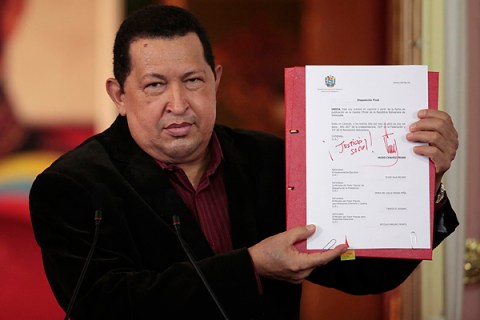
Venezuelan President Hugo Chávez holds the signed new labor law during a national TV broadcast in Caracas on April 30, 2012
Venezuela Shortages — Venezuela faces a shortage of basic consumer goods, which has raised concerns about the viability of President Hugo Chávez’s socialist economic policies, notes the Christian Science Monitor. Staples such as sugar, milk, chicken and harina pan (corn flour used to make arepas — corncakes that are common in the Venezuelan diet) are hard to find in the markets, writes CSM. Critics say Chávez’s economic policies have deterred domestic production of food, but the government has blamed businesses for the shortages.
Smartphone Frontiers — The New York Times reports that India, Russia and Brazil should be targeted as smartphone frontiers, as a majority of phone users in those countries use older types of cellphones. About half of the phone users in Brazil and Russia have smartphones while only 10% have them in India, according to a study by research firm Nielsen. “In the coming years,” forecasts the Times, “manufacturers will be fiercely competing for the remaining non-smartphone owners, who are mostly in emerging countries.”
Romanian Orphans — The Global Post examines the difficulties Romanian orphans face in making their own way after they leave orphanages. In Romania, the fall of communism in 1989 exposed the shocking conditions of state-run orphanages and improved the lives of many abandoned children. More than two decades later, however, the Eastern European country’s orphanages are failing to give guidance on how the orphans can survive once they leave. According to Global Post, “the state still provides no formalized life-training program or ongoing support for the estimated 70,000 children who fall under the care of the Department of Child Protection, let alone the tens of thousands more believed to live on the streets.”
Algeria Hostages – An Algerian security source says that there were 30 casualties in Thursday’s attempt to rescue hostages being held captive by a jihadist group, writes the Guardian. It is believed that 11 captors and several westerners, including Japanese, French and British nationals were killed in the Algerian led attack. Mohamed Said, the Algerian communications minister, has justified the rescue attempt, saying that they had no choice but to act due to the “diehard” attitude of their captors. London, Washington and Paris have indicated that they were unaware of the military operation to free the hostages. British Prime Minister David Cameron gave a statement in the House of Commons Friday, expressing “disgust and condemnation” at the “brutal and savage attack.” Follow the Guardian’s live updates of the hostage crisis as it progresses.
Bolshoi Attack – The artistic director of the Russian Bolshoi Ballet was injured in an acid attack on Thursday night, said the New York Times. Sergei Filim, 42, signed a five-year contract as the ballet’s director in 2011, and was left with third-degree burns and potential blindness after a masked man threw acid in his face outside the dancer’s home. Doctors said his recovery could take as long as six months. Investigators believe that Filin was most likely targeted because of his work, following a stream of anonymous threats since becoming artistic director. It’s believed he will need to travel overseas for treatment, most likely to Germany or Israel.
Zimbabwe Constitution – President Robert Mugabe and Prime Minister Morgan Tsvangirai, leaders of Zimbabwe’s rival political parties, have agreed on the final draft of a constitution which will be put to a referendum, reports Al Jazeera. The new laws will increase the power of parliament, set a 10-year presidential term limit, and remove any presidential immunity. Mugabe explained that “the finalization of the draft is now being made,” however he did not say when a referendum will be held. Mugabe and Tsvangirai have led a power sharing government since 2009.