


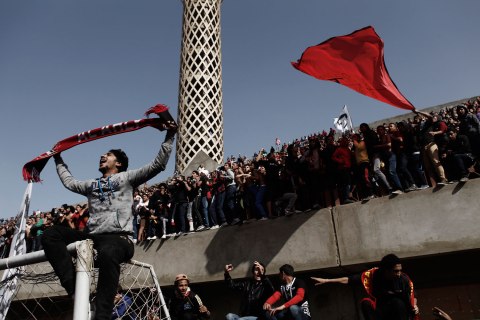
Al-Ahly "ultra" fans gather at the soccer team's stadium in Cairo on Jan. 26, 2013, to celebrate the announcement of death sentences for al-Masry fans who were involved in a stadium massacre last year
The second anniversary of the Egyptian revolution on Friday was an unhappy affair, but the violence that accompanied it was merely a precursor to the greater bloodshed that came on Saturday. Together, the two days of turmoil brought the precarious state of modern Egypt into full display — with dual sources of unrest and potential mayhem.
At 10 a.m. on Saturday, the first batch of verdicts was delivered in Egypt’s worst-ever instance of soccer violence. After announcing the death sentence for 21 civilian soccer fans for a Port Said team, the judge practically ran out of the courtroom. Who could blame him? This case had been particularly vicious. On Feb. 1, 2012, after a match between Cairo’s al-Ahly club and Port Said’s al-Masry club, fans of al-Masry stormed the field and attacked their rivals. Police on the scene largely stood aside and in the ensuing violence and stampede, 72 people — mostly al-Ahly fans — were killed. A total of 73 people were eventually put on trial over the incident — ranging from al-Masry club fans and club officials to senior police officers accused of neglect. Hardcore al-Ahly fans, known as ultras, have repeatedly demanded justice for their martyrs and threatened violence if they weren’t satisfied.
At Saturday’s verdict, the hundreds of al-Ahly fans gathered in Cairo exploded into celebration; residents of Port Said, however, merely exploded. Within minutes of the verdict, Port Said natives attempted to break into the local prison where the convicted defendants were being held. As of Saturday evening, the death toll in Port Said had risen to at least 30 people, and the army had been deployed in the city.
(PHOTOS: Egypt’s Revolution in Retrospect: TIME Goes to Tahrir Square)
The Port Said case is deeply intertwined with the revolution and its aftermath. The ultras actively participated in the revolution and emerged afterward as implacable enemies of both the police and the Supreme Council of the Armed Forces. A hardcore contingent of ultras insists the Port Said deaths were not the result of official negligence but rather were orchestrated by the security deep state to punish them for their opposition.
The Port Said fans, meanwhile, claim the verdict was politicized and that their people are being sentenced to death on thin evidence simply to appease the ultras. Tellingly, neither side seems to have much faith in an impartial and depoliticized judicial system.
And despite their jubilation on Saturday, al-Ahly ultras could still turn on the government. While Port Said burns, all eyes now turn to March 9, when another 52 defendants — including several senior police officers — face their own verdict. If those security officers go free or receive light sentences, the ultras have already promised to react with violence.
All that foreboding combines with the political unrest that continues two years after the fall of Hosni Mubarak. Around 7 p.m. Friday, Tahrir Square was an angry, chaotic and red-eyed place. Tens of thousands of protesters had spent the past several hours shouting angry chants against the government, President Mohamed Morsi and the Muslim Brotherhood — the powerful Islamist organization that is the backbone of his support. Many of these chants (“We won’t leave, he should leave!”) were directly lifted from the original revolution exactly two years ago — back when Morsi and his Brotherhood were erstwhile partners with the largely secular forces that now bitterly oppose him.
(MORE: ‘No Glimmers of Hope’: Two Years After Egypt’s Revolution, an Economic Crisis Looms)
A fresh wave of tear gas wafted into the center of the square from the back-and-forth clashes with police along Tahrir’s northern edge about 1,000 m away. As noncombatant protesters scattered and gagged, Salah Anani, a prominent artist and activist, wrapped his scarf over his eyes and continued speaking in a strained voice over a microphone — making it clear that the two-year-old revolution to oust Mubarak had merely revealed a fresh enemy. “My friends, these are the filthiest people in the world,” Anani said. “I know we thought that Hosni Mubarak was the filthiest, but the Brotherhood are even filthier.”
Given the bitterly polarized state of the country, it’s no surprise that Friday’s second anniversary of the revolution’s beginning was hardly an occasion for celebration. The mood started out angry and escalated from there. One indication of the spirit of the day: none of the participating groups and parties even bothered to erect a stage. Previous large Tahrir protests had often featured multiple elaborate stages, mixing crowd-pleasing revolutionary songs in with the speeches. This time the most you could find was individual speakers shouting into bullhorns and microphones.
Another telling indication of the angry and confrontational mood of Egypt’s anti-Brotherhood forces: Friday’s protests marked the public debut of a new and openly militant faction of the opposition. The Black Bloc — a self-styled anarchist militia modeled on European predecessors — came into the day with the announced intent of battling police and damaging both government buildings and offices connected to the Brotherhood.
Dressed all in black and concealing their faces with bandanas and balaclava ski masks, the emergence of the Black Bloc represents a potentially divisive new turn for Egypt’s revolutionary opposition. Their appearance in the hundreds on Friday touched off an immediate debate as to their seriousness and the implications of their openly violent stance.
(MORE: Cairo’s New Normal: Protests Spawn a World of Walls and Barricades)
Some of Egypt’s veteran revolutionaries took to openly mocking Black Bloc members as a bunch of kids playing dress-up who had clearly watched V for Vendetta too many times. Others fretted that this trend would backfire, making it even easier for Morsi and his government to demonize the opposition as radical saboteurs.
Veteran revolutionary Tarek Shalaby made his contempt for the idea clear on Twitter, calling the Black Bloc cadres “a bunch of idiots in face masks.” He also tweeted: “If this Black Bloc sh-t isn’t just a fashionable trend that dies out soon, MB and SCAF are going to use it against #Jan25.”
In retrospect, it doesn’t appear the Black Bloc members made much of a tactical difference on the front lines on Friday. They, along with others, battled riot police on multiple fronts throughout the night and apparently attempted to attack the offices of an Islamist website downtown, leading to a disastrous confrontation with vendors at a nearby vegetable market. But there has always been a contingent of Egyptian activists willing to physically battle the police and attack government buildings. After all, Egypt’s “peaceful” revolution was never as peaceful as some remember it; the peaceful protesters would never have been able to take over Tahrir in the first place two years ago without an organized and motivated effort to physically defeat the police state.
However, the Black Bloc’s emergence speaks volumes about the mood among anti-Brotherhood forces, which have seen the country’s Islamist forces repeatedly defeat them at the ballot box and ram through a divisive constitution despite their opposition. Going forward, the group seems likely to serve as rallying point for the Egyptian revolutionaries who have abandoned all hope of change through negotiation or peaceful means.
Ashraf Khalil is a Cairo-based journalist and author of Liberation Square: Inside the Egyptian Revolution and the Rebirth of a Nation
MORE: Egypt’s President Morsi Got His Constitution, but Can He Fix the Economy?
PHOTOS: The New Battle for Egypt