Must-Reads from Around the World

  • Share
  • Read Later
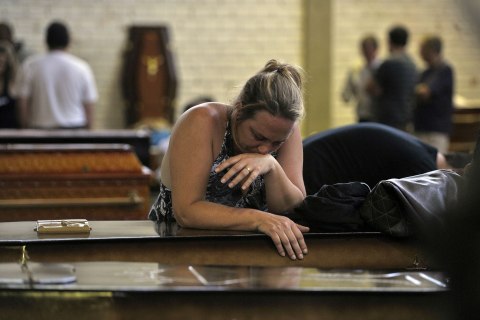
LAURO ALVES / AGENCIA RBS / AFP / Getty Images

The relative of a victim of the the Boate Kiss nightclub fire mourns over a coffin in Santa Maria, Brazil, Jan. 27, 2013.

Brazilian Nightclub Disaster – At least 230 people died in a nightclub fire on Saturday night in the university town of Santa Maria in southern Brazil, reports the Rio Times. The disaster occurred in the state of Rio Grande do Sul, one of the wealthiest, most industrious and culturally distinct regions of Brazil. It’s believed the fire was ignited by sparks from a pyrotechnics show used by one of the performing musicians. “It’s the saddest, saddest day of my live,” Neusa Soares, the mother of one of the deceased, told the Buenos Aires Herald. “I never thought I would have to live to see my girl go away.” Brazilian president Dilma Rousseff has cut short her official visit to Chile to be with the relatives and friends of those lost in the blaze. The disaster follows other nightclub related tragedies in the last decade, including the Buenos Aires blaze that killed nearly 200 in 2004, and the fire in Perm, Russia in 2009, where over 100 people perished.

Argentine-Iranian CommissionArgentina and Iran will establish a joint commission to investigate the bombing of a Jewish community center in Buenos Aires nearly 20 years ago, reports the BBC. The attack on the Israeli-Argentine Mutual Association (Amia) on July 18, 1994, killed 85 people. Argentine courts have blamed Iran for the bombing but Iran has denied any involvement in the incident. Under the agreement, Argentine legal officials will be able to question Iranian suspects in Tehran. Five independent judges, none of whom will be from either Iran or Argentina, will be the members of the commission.

Italy’s Tax Cheats — The New York Times examines the Italian government’s latest efforts to clamp down on tax evasion. The National Revenue Agency’s new strategy attempts to infer how much suspected tax evaders earn by looking at their spending habits. Their new tool of choice is the “redditometro,” or income measurer, which examines dozens of spending categories, such as household costs, vacations, cellphone usage, clothing and car ownership. If a taxpayer’s expenditures seem more than 20% greater than the income he has declared, the agency will ask for an explanation, writes the Times. Critics of the redditometro have said it will discourage consumer spending and hurt businesses.


Not So Much Out of but In Africa — China’s media footprint continues to grow in Africa, following the launch of Africa Weekly by the China Daily, notes Al Jazeera. While major media outlets from other countries are closing bureaus in Africa and elsewhere, Chinese media outlets are expanding overseas to increase China’s soft power. In 2009, Beijing reportedly set aside 45 billion yuan ($7.2 billion) for the global expansion of state media. Such overtures in Africa have led some critics to believe that “Chinese media emphasize positive, feel-good stories about the continent,” rather than promote journalism, writes Al Jazeera.

Venezuelan Prison Riots – Venezuelan authorities have transferred prison inmates following riots within the jails late last week, which left 58 people dead, reports Reuters. Prisons Minister Irish Varela has acknowledged that corruption among prison workers has led to weapons smuggling which allows armed gangs to control the packed Uribana jail in the southwest of the country. Varela confirmed that 2,000 male prisoners and 130 female prisoners had been transferred to separate institutions. Authorities failed to carry out an inspection at Uribana on Friday to seize weapons when faced with armed resistance. Meanwhile President Chavez, who has been undergoing treatment for cancer in Cuba, has not been seen in public in 45 days.

Berlusconi defends Mussolini – Former Italian Prime Minister, Silvio Berlusconi, has sparked outrage following a series of comments he made Sunday defending the country’s wartime fascist leader, Benito Mussolini, notes Aljazeera. At a ceremony commemorating the victims of the Nazi Holocaust, Berlusconi told his audience that although Mussolini was wrong to follow Nazi-Germany, he had been a good leader in other ways. Berlusconi, who was also accused of falling asleep at the ceremony, succeeded in grabbing headlines with his controversial remarks, bringing energy to a “hitherto lackluster campaign,” writes the Guardian.

5 comments
Sort: Newest | Oldest
famulla5
famulla5

In order to keep up the recovery momentum in the world economy, International Monetary Fund chief Christine Lagarde today asked countries and their leaders to "I will pursue with 'do not relax' principle. The forecast is for a very fragile recovery in 2013 and that is why I will emphasise on do not relax," Lagarde said here at the World Economic Forum(WEF) Annual Meeting. Speaking at a session on the global economic outlook, she said central banks across the world have taken some tough decisions in the recent past and some political leaders are also doing their part on recovery process. "Some difficult decisions are still due in the US and Europe. Follow the 'do not relax' principle and not let complacency come into their efforts. The competitiveness of Eurozone has to be there," she said, adding that growth has certainly picked up in the US. "For emerging economies, particularly China, re-balancing the business model towards more domestic and more consumption- oriented and less export-focused is going to be there," the IMF Managing Director said. The panellists noted that the recovery process has only began and was far from over.  I thank you Firozali A.Mulla DBA

LoveMy_Ninja
LoveMy_Ninja

@TIME No thanks! The world is pretty F up. But hey, nobody cares.

famulla5
famulla5

ON EURO The United States and the European Union are wrapping up final preparations for talks on a free-trade agreement that would encompass half the world's economic output, Europe's trade chief said on Saturday, while warning of "difficult negotiations." EU Trade Commissioner Karel De Gucht will travel to Washington on February 5 to put the finishing touches on a joint EU-US report. He gave his clearest signal yet that Brussels and Washington are ready to embark on the accord. "Essentially the report is ready. I will go to Washington to discuss a couple of small items and for a final reading. But essentially we're on the same page," De Gucht told Reuters in an interview in the Chilean capital Santiago. "These will be difficult negotiations." A trade deal between the world's two largest economies encompassing 800 million people would unleash billions of dollars in transatlantic business, advocates say. It could also allow Europe and the United States to define the rules of global trade before China and India do. The 27-nation European Union and the United States already account for nearly a third of world trade, but a banking and debt crisis in Europe and meager American growth are pushing both sides to consider removing the final barriers to trade. US companies have invested some $1.9 trillion in production, distribution and other operations in the EU, far more than in China. EU companies have invested about $1.6 trillion in the United States. 'No low-hanging fruits' Given concerns about getting caught up in endless negotiations, US President Barack Obama and EU leaders called on an expert group co-chaired by EU Trade Commissioner Karel De Gucht and US Trade Representative Ron Kirk to decide whether it was worth going ahead. De Gucht said there was momentum for an agreement. "We will have a common recommendation. If we were of the opinion that it was not worth trying, we wouldn't have put in this much time," he said. A deal could increase Europe's economic output by 65 billion euros a year, equivalent to a 0.52 percent rise into the EU's gross domestic product, according to the European Commission, benefiting industries from chemicals to automakers. Both sides know negotiations will require compromises. The United States and the European Union already have low tariffs on their goods, but what businesses really want is access to each others markets through common regulations. They would like to see a pact, for example, in which a car tested for safety in the United States would not have to be tested again in Europe, and a drug deemed safe by Brussels would not have to be approved by the US government as well. "It's not about low-hanging fruits or an early harvest," De Gucht said. "I have no illusions that this will be easy." I thank you Firozali A.Mulla DBA


SeqStuff
SeqStuff

Such a sad story about the Brazilian nightclub fire :(   Please correct the fourth sentence of the story that reads, “It’s the saddest, saddest day of my live,” Neusa Soares...  It probably should read, "of my life", not "live".  

Prayers to the families..