Skip to Content
TIME

World

Sections →

  • Home
  • NewsFeed
  • U.S.
  • Politics
  • Egypt

    Revolt of Egypt’s Canal Cities: An Ill Omen for Morsi

    By Ashraf KhalilJan. 29, 20130
    • Share
    • Read Later
      • Send to Kindle
    Mohamed Abd El Ghany / Reuters

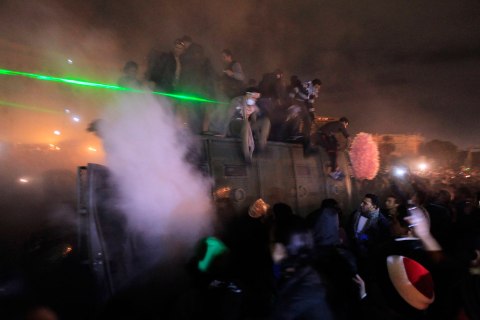
    Anti-Morsi protesters stand on a riot-police vehicle after seizing it on the Qasr al-Nil Bridge to Tahrir Square in Cairo on Jan. 28, 2013

    • Email
    • Print
    • Share
      • Facebook
      • Twitter
      • Tumblr
      • LinkedIn
      • StumbleUpon
      • Reddit
      • Digg
      • Mixx
      • Delicious
      • Google+
    • Comment

    Follow @TIMEWorld

    Memory is implacable in Egypt’s three major cities on the Suez Canal: Port Said in the north, Ismailia in the middle and Suez in the south. There is still vestigial rancor from British colonial days; and there is a hardened sense of honor and neglect from being at the front lines of the wars with Israel in the 1960s and ’70s. Those emotions have often turned inward, against Egypt itself and whoever rules from Cairo. The first martyrs in the January 2011 revolt against Hosni Mubarak were from the canal cities, and their blood fed a nationwide cry for vengeance. Now President Mohamed Morsi finds his greatest popular challenge not in the huge urban centers of Cairo or Alexandria but in the three troublesome cities.

    It was no surprise that Egyptian police lost control of Port Said almost immediately after a Cairo court handed down death sentences on Jan. 26 to 21 residents from the canal city for their alleged role in a February 2012 soccer riot that killed 72 people. In the aftermath of the verdict, relatives of the condemned laid siege to the local prison and would have breached it if Morsi hadn’t called in the army. At least 30 people were killed in the mayhem — a toll that easily eclipsed the police action visited upon the more cogently political protests in Tahrir Square in Cairo. The bloodshed simply contributed to the local sense of outrage and marginalization. As one Port Said resident screamed to the cameras of al-Jazeera: “We bled for this country! We died for Egypt’s freedom! Why is our blood so cheap now?”

    (PHOTOS: Cairo’s Latest Uprising, Two Years After Revolution)

    The President imposed a 30-day state of emergency and nightly curfews in Port Said, Suez and Ismailia. The residents were unfazed; indeed they took to Morsi’s declaration of a 9 p.m. curfew with a rebellious gusto, making a point of scheduling their protest marches to start at 8:45 p.m.

    For decades, the cities have been a tribe apart within of Egypt. The last British battalion left Egypt in 1956 but, way into the 1990s, citizens of Ismailia would mark an annual spring holiday by burning effigies — the older residents would sort of recall that burning man was supposed to be Lord Edmund Allenby, who led British forces in the Sinai in 1917 and 1918. The tradition persisted for so long that younger residents had no idea who “Limby” was and took to burning effigies of more modern enemies of Egypt, like Ariel Sharon.

    Port Said is particularly known for a contrarian streak. In the 1990s — at the height of Mubarak’s dominance — the city continued to elect a string of opposition politicians to parliament. And when the country erupted on Jan. 25, 2011, against Mubarak, the martyrs of Suez contributed momentum and intensity to a struggle, providing impetus to Cairo-based revolutionaries who were struggling to establish control over Tahrir Square.

    (MORE: Blood in Egypt’s Streets: Anger in Tahrir, Then Soccer Violence in Port Said)

    This time around, however, the anger in Suez, Port Said and Ismailia is a kind of street-based, almost anarchic ferocity that cannot be easily contained by the political slogans of Tahrir Square. Unlike the events of January 2011, the current uprising is partly sports fanaticism, partly generalized anger at feeling maligned by courts that the locals feel favor the followers of the Cairo’s soccer team. Nevertheless, the convulsions are the greatest threat to date to Morsi’s seven-month-old administration. The longer the violence persists — and the more new martyrs are created — the greater the likelihood that the emotions of the canal cities will spiral and spread. Clashes have continued for days in Tahrir Square and parts of Alexandria, but these remain fairly static and contained situations without the mass turnouts that would tip Morsi’s administration into crisis. The longtime Muslim Brotherhood official calculated that he could afford to look like a dictator when he granted himself nearly autocratic powers in late November in order to ram through a highly divisive constitution. What he can’t afford to do is look weak or unable to keep the peace.

    That need to look strong was evident in Morsi’s Jan. 27 evening address to the nation. Gesturing angrily and nearly shouting at several points, he came off like an angry patriarch whose patience with his unruly children was wearing thin. In announcing the state of emergency and curfew for the canal cities, he offered an undisguised threat: “I’m willing to do a lot more for the sake of Egypt!”

    (PHOTOS: Egypt’s Revolution in Retrospect: TIME Goes to Tahrir Square)

    Exactly what “a lot more” means remains an open question. As the crisis deepens, Morsi has come to rely more and more on Egypt’s armed forces. On Monday, Egypt’s Shura Council — the upper house of parliament that is serving as the entire legislative branch until elections scheduled for sometime this spring — passed an ominous resolution granting the military the right to arrest civilians around the country unconditionally. This potentially puts the Egyptian army back into a position of conflict with its civilians, with no real public indication of how the current military leadership feels about being thrust into this role. The army leadership’s refusal to attack civilians was the final straw that forced Mubarak from the stage two years ago.

    For more than a year after that, the Supreme Council of the Armed Forces ran the country and managed to alienate almost every significant political force in Egypt. When Morsi succeeded in outmaneuvering his military rivals and sending Defense Minister Mohamed Hussein Tantawi into retirement, it was taken as a welcome end to the era of direct military involvement in politics. Tantawi’s replacement, General Abdel Fatah al-Sissi, has kept a deliberately low profile since then.

    Morsi is not Mubarak. He was elected, albeit by a slim margin, and his main political support — the Muslim Brotherhood — has had the ability to marshal enough votes in national referendums to continue to claim at least a shaky popular mandate. But soon Morsi may not have the luxury of appearing in firm civilian control without calling upon the military. The police have officially lost control of Port Said, and the people there and in the other canal cities seem determined to force further confrontations with Morsi’s government. And the harsher Morsi reacts, the more he will be compared to the President that came before him. That is a parallel he does not want.

    MORE: Cairo’s Anxious Days: The Revolution’s Anniversary and a Soccer-Riot Verdict

    8 comments
      Livefyre
    • Get Livefyre
    • FAQ
    Sign in
    + Follow
    Post comment
     
    Link
    Newest | Oldest
    MoamenZyan
    MoamenZyan 5pts

    The Egyptian people do not dismiss a terrorist ...Egypt got a gun and fake elections. Then used the weapon to kill Egyptians now streets ... And the Egyptian revolution now on terrorism and the whole world must be understood. And to help the Egyptian people......

    IshaCNN
    IshaCNN 5pts

    이집트 무르시 대통령의 이슬람국 개조 시도에 운하3개시 저항은 매우 안좋은 징조라네요. 지켜볼만.. @TIME:What the revolt of Egypt's canal cities means for Morsi http://t.co/BgmsuXdl

    Abdelmageed84
    Abdelmageed84 5pts

    @abkamal أندهش حينما أراك تدافع عن حرية الشعب وحقوقه رغم أنك كنت أحد أكبر المدافعين عن المخلوع وتوريث نجله

    SirDonQuixotic
    SirDonQuixotic 5pts

    I think the bigger story here is that the protesters (or the police) clearly seem to have green laser weapons they're firing around.

    TizzAlNabi
    TizzAlNabi 5pts

    What a joke the Western Press is. What happened to the Arab Spring? The great headlines in Time, the New York Times proclaimed democracy in the Arab countries. What did we get? Anti-American anti-women, xenophobic Islam theocracies.

    SeniorMoment
    SeniorMoment 5pts

    There are some traditional football rivalries between major cities with football fields, but the drunks and violent people are evicted from the stadium and area of the game, which encourages peaceful cheering and screams of excitement instead of bloodshed. After all no true fan with season tickets in a sold out game city such as Denver, CO, would ever be willing to risk the loss of their season pass and eviction from the stadium. It can take years in line for a season pass to even get one again and both the stadium and the home team at the stadium can take away access to future games. Denver Bronco fans are so fanatical that even 20 years ago the team could expect a sell out of its share of tickets to the SuperBowl at a cost for ticket and attendance of at least $2,000, which now after inflation is equal to about $3,327 and yet two people I worked with came up with the money to go to the SuperBowl from Denver the first time the Denver Broncos did well enough to compete in it. That is about 22,258 Egyptian Pounds at current exchange rates just to get to the stadium with a ticket and overnight lodging in the event's city.

    Fans in US football do occasionally die, typically from one at a time from falls without anyone pushing them over a railing or stadium wall.

    ViableOp
    ViableOp 5pts

    As shown here, Morsi and Egypt control a very key part of the world's economy; safe passage of oil through both pipeline and canal:

    http://viableopposition.blogspot.ca/2012/06/egypts-petroleum-industry-point-of.html

    SeniorMoment
    SeniorMoment 5pts

    Having been a focus center of British control of the Suez Canal, it is not at all surprising that three cities by the canal would be contrary places.  In another generation they will probably be more like the rest of Egypt.  I just hope that Egypt can form a stable democracy before too much more time, because if not the nation will become another dependent of international food relief programs.  A prosperus economy demands the rule of law.

    As far as murden convictions for rioting soccer fans, that is the consequence of even acting more unruly than the detested Hooligan Soccer Fans. from the U.K.  Perhaps the Egyptians learned too many British behaviors.  I thought football in the USA was a more violent game than soccer, but I can't recall when a football stadium erupted in rioting that resulted in deaths, even though there are plenty of football fans who are just as fanatical in their support of their team as the rest of the world is about soccer.

    In This Week's Issue

    The New Wave of Internet Leakers

    U.S. and China Take a Vital Step Forward

    France's Intervention in West Africa is Turning into a Lengthy, Complicated Affiar

    Latest from our Partners

    John Boehner: No Vote On Immigration Bill Without Majority Support Of Republicans — Huffington Post

    “Stink Onions,” “Heart’s Farm,” “Place to Find Gold”: Literal Names of U.S. Places, Mapped — Slate

    Justices Pass On Rulings — Huffington Post

    • Most Popular
    From World
    1. What Brazil’s Protests Say About Latin America’s Fumbling Elites
    2. Brazil’s Protests: Social Inequality and World Cup Spending Fuel Mass Unrest
    3. Scenes from Brazil’s Angry, Nationwide Protests
    4. Rouhani’s Opposition to the Bomb: The Iranian President-elect’s 2006 Letter to TIME
    5. Sex, Lies and Photoshop: China’s Racy-Photo Scandals
    From Time.com
    1. James Gandolfini (1961-2013): As a Made Man, He Made TV Great
    2. Top 10 Sopranos Episodes
    3. Critics of the Liberal Arts Are Wrong
    4. Review: Long Live the New MacBook Air
    5. 'Sopranos' Star James Gandolfini, Dies at 51

    Latest Tweets

    Catherine Mayer@catherine_mayer2h
    A sad day. RIP Tony Soprano - and the great actor who created him, James Gandolfini. @poniewozik writes http://t.co/p9U1j8hFMt
    • Reply
    • Retweet
    • Favorite
    Aaron Bady@zunguzungu3h
    I am going to keep using google-reader until the bitter end. #downwiththeship
    Retweeted by Stephan Faris
    • Reply
    • Retweet
    • Favorite
    Tony Karon@TonyKaron3h
    Rodgers, Bard of Mersey? First a striker called Iago, now a quality treqartista whose dad is named Hamlet... http://t.co/lq5HfcGkoI
    • Reply
    • Retweet
    • Favorite

    Connect With TIME

    Sign up for TIME's world newsletter

    More photosPhotography

    • Protesters Throng Brazil's Streets to Rail Against Government Corruption
    • A Bear Grows in Brooklyn: Portraits of Rosie, a Furry Star of the Forties
    • The Myth and Mystery of the Sunshine State

    Search for Jobs

    Indeed
    • iPad
    • iPhone
    • Android
    • TIME TV
    • Populist
    • The Page
    • TIME Home
    • NewsFeed
    • U.S.
    • Politics
    • World
    • Business
    • Tech
    • Health
    • Science
    • Entertainment
    • Photos
    • Videos
    • Lists
    • Magazine
    • © 2013 Time Inc. All rights reserved  
    • Privacy Policy
    • Your California Privacy Rights
    • RSS
    • Newsletter
    • Mobile
    • TIME For Kids
    • Subscribe
    • Contact Us
    • Terms of Use
    • Media Kit
    • Reprints & Permissions
    • Help
    • Site Map
    • Ad Choices
    • Custom Content
    Powered by WordPress.com VIP
    TIME logo

    our partners

    CNN logo CNN Money logo