


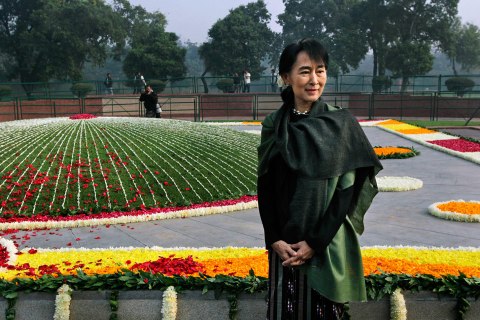
Burma's opposition leader and Nobel laureate Aung San Suu Kyi stands after paying floral tribute at the memorial of India's first Prime Minister Jawaharlal Nehru on his birth anniversary in New Delhi, India, Nov. 14, 2012.
Burma Peace Talks – Burma’s opposition leader Aung San Suu Kyi is willing to mediate an end to violence between the government and the country’s ethnic minority groups, which could lead to a formal invitation from the government to participate in negotiations with Kachin rebels, the Guardian reports. Suu Kyi made the announcement on Union Day on Feb. 12, which celebrates the day in 1947 when her father signed an agreement with leaders of Burma’s ethnic minorities to gain independence from British colonial rule, the daily points out. The Nobel laureate has drawn fierce criticism for not taking part in peace talks regarding the Kachin conflict, notes Al Jazeera.
Peruvian Amazon Gas – The Guardian reports that energy company Pluspetrol is eyeing gas reserves at Manú National Park in the Peruvian Amazon. The United Nations Education, Scientific and Cultural Organization (UNESCO) says the biodiversity at the national park “exceeds that of any other place on Earth” and is home to indigenous people who do not have regular contact with the outside world, notes the Guardian. UNESCO has declared the park a World Heritage Site and biosphere reserve. The disclosure about Manú and a possible expansion of hydrocarbon activities into the park comes amid rumors and reports that the Peruvian government will create a gas concession that borders or includes parts of it; however, the daily said those reports have not been publicly confirmed. Peruvian law prohibits extractive operations in national parks.
Curfew Continues – The government-imposed shutdown in Indian-administered Kashmir has been continued in order to contain unrest after Muhammad Afzal, also known as Afzal Guru, was hanged for plotting to attack the country’s parliament in December 2001, the New York Times reports. Authorities have blocked roads to Afzal’s hometown of Sopore after separatist groups threatened to march there on Tuesday to mark his death, said the BBC. Many residents are running out of food and milk in Srinagar, Kashmir’s summer capital, and dozens have been injured with at least one person killed in protests against Afzal’s hanging, which, according to the New York Times, happened secretly in Delhi on Saturday and was announced afterward. The ban on movement of people and vehicles in Kashmir was imposed under India’s criminal procedure code, which was referred to after protests over the recent Delhi gang rape, and prohibits the assembly of more than four people, notes the New York Times.
Iran Elections — Iranian president Mahmoud Ahmadinejad has accused his political rivals of plotting to rig the forthcoming presidential election, reports the Times of London. In a speech marking the anniversary of the Islamic Revolution, Ahmadinejad accused a number of regime officials of corruption. “Some people have said they can engineer the election,” he said during a speech marking the anniversary of the Islamic Revolution. He was referring to recent comments by Iran’s Supreme Leader Ayatollah Ali Khamenei’s representative in the Revolutionary Guard, who recently declared that the militia had “a responsibility to engineer a rational and logical election.” This goes against Ayatollah Ali Khamenei, who has tried to discourage debate within the regime about the fairness of the elections, writes the daily. Ahmadinejad also defied the Ayatollah by announcing that he was ready to talk to the Americans over Iran’s nuclear standoff with the West. Khamenei last week ruled out bilateral talks with the United States, notes the Times.
Pope Resignation — Pope Benedict XVI has made his first public appearance since announcing his resignation, reports the BBC. On the day he will hold what is expected to be his last public Mass, for Ash Wednesday, he thanked the public for their “love and prayers.” The 85-year-old pontiff said he was stepping down “for the good of the church,” reports the Independent. The daily notes that during his time in the Vatican, the then Cardinal Joseph Ratzinger saw first-hand the failing health of his predecessor John Paul II – leading him to believe that Popes should step down if unable to do their jobs. Vatican officials said Benedict will continue with his planned engagements until the day he officially retires at the end of February, writes the BBC. There is expected to be a new Pope by the end of Lent, in six weeks’ time.