The European Slump: France Gives Up Lowering Its Budget Deficit

  • Share
  • Read Later
BERTRAND LANGLOIS / AFP / Getty Images

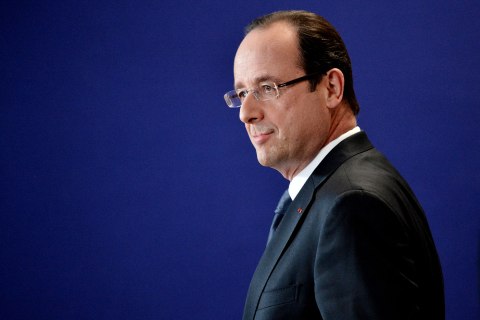
French President François Hollande attends a press conference at the E.U. headquarters in Brussels on Feb. 8, 2013

Poorer-than-expected economic news completely outed what was already the worst-kept secret in France. On Feb. 14, members of socialist President François Hollande’s government admitted they wouldn’t meet their 2013 target of keeping the budget deficit to 3% as previously (and incessantly) promised. That avowal was hardly a shocker: until now, the only people taking the 3% pledge seriously were the same French government officials who continued citing it despite increasingly dire economic statistics. But with figures for the fourth quarter of 2012 showing growth levels worse than feared, even Team Hollande conceded that meeting the 3% deficit objective had become the stuff of fantasy.

“We won’t be exactly at 3% for 2013, I believe, for the simple reason that growth in France, Europe and in the world is weaker than expected,” socialist Prime Minister Jean-Marc Ayrault said after official stats indicated the French economy shrank by 0.3% in Q4 2012, while growth across the euro zone was expected to decrease to around 0.6%. “[But] the objective — and it will be met — is 0% [budget] deficit by the end of [Hollande’s] five-year term, and what’s important is trajectory toward that.”

(MORE: It’s Official: Euro Zone Enters Second Recession in Three Years)

That “focus on the bigger target” message is one Hollande and his government have continually peddled to French voters and E.U. officials — especially as the economic outlook has darkened. Yet despite the abandonment of the 3% deficit-reduction target for this year, Ayrault’s assurances on progression to the larger, further balance-budget goal aren’t unfounded. The French deficit that ballooned to 7.1% in 2010 was first lowered to 5.8% in 2011 under conservative rule, and further cut to an expected 4.5% this year after the election of Hollande and fellow leftists last year. The goal of bringing it down this year to 3% — the official maximum allowed for euro members — was set within a range of economic policies and reforms that combined cuts, targeted stimulus spending and increased taxes. That approach, Hollande pledged, would stimulate France’s slumping economy enough to allow him to gradually remedy French public finances enough to table a balanced budget in 2017.

That has proved a far trickier act to pull off — especially amid confounding economic activity reflected in Thursday’s Q4 statistics. Indeed, some observers question Hollande’s ability to attain longer-term objectives for the same reasons that he’s suffered short-term setbacks: the persistently dismal growth levels that undermine the French plan don’t look set to rise anytime soon. The same is true for euro-zone partners the French do business with — as Thursday’s numbers again confirmed.

France’s 0.3% shrinkage in the past three months of 2012 was one of Europe’s better performances. Germany — by far the euro zone’s healthiest economy — declined 0.6% during the same period. That drop — blamed on flagging export activity the German economy relies heavily on — was Germany’s worst performance since early 2009. The wider picture is no better. Economists expect Q4 growth for the 17-nation euro zone to be down 0.6%, and there’s little hope the bloc will pull out of its prolonged recession anytime too soon.

France offers a fairly good example of why things look so bleak for Europe generally. France’s virtually flat growth rate in 2012 was one of the least dismal results in the euro zone — but even that pales what was an already anemic 1.7% French increase in 2011. With most economists expecting the French economy to recede by at least 0.1% in the first quarter of 2013 (which would officially signal France’s re-entry into recession), the government’s projection of 0.8% growth for the year is clearly too good to be true. Right on cue, French Economy and Finance Minister Pierre Moscovici responded to Q4 figures saying governmental growth estimates for 2013 would be “rethought.”

“The situation isn’t good, and the numbers are worrying,” Moscovici told France 2 TV, where he also echoed Ayrault’s concession that the government wouldn’t be able to meet its 3% deficit reduction amid such bad economic conditions. “The question that has to be asked is one of [deficit-reduction] rhythm.”

In other words, stay the course despite the bad news and remain focused on the bigger targets. That message is one Hollande himself has been repeating to the French public, with warnings that France’s economic and employment situation will continue declining through mid-2013. But at that time, Hollande assures, policy decisions and reforms he’s undertaken will begin turning the situation around as growth returns. That virtual spiral of resumed activity and job creation, he vows, will continue getting better as France and its partners overcome the financial crises they’re battling, and see economic activity rebound in a way that benefits them all.

That’s a message of patience, however, that voters in France — and doubtless elsewhere in the suffering euro zone — are growing weary of. December saw the 19th consecutive month of increased jobless numbers in France, lifting the unemployment rate to 10.7%. Destruction of the nearly 67,000 posts in France in 2012 is set to accelerate as the economy continues to flatline or sink as 2013 wears on. Few observers foresee any significant improvement soon.

Beyond the French government’s soon-to-be-revised 0.8% growth projection, the most optimistic forecasts for France include the European Commission’s predicted 0.4% expansion and the International Monetary Fund’s 0.3% estimate. Neither of those would allow Hollande to meet his sacrosanct 3% deficit target without further spending cuts — an option the President clearly viewed as begging for additional trouble from France’s already exasperated public.

It remains to be seen whether expensive concessions like that will convince the French to overlook Hollande’s short-term setbacks and to look forward to his fulfillment of bigger goals. It’s a risky bid. By sacrificing the 3% objective with which he justified earlier spending cuts, Hollande has many French voters already wondering where the gain is that their pain was meant to produce. It also has them asking whether long-term goals will prove just as elusive as the short-term ones have been.

MORE: The E.U. Budget: Champions of Austerity Win a Big Battle — for the Most Part

13 comments
famulla5
famulla5

"The EU caused a storm of protest from the banking sector last week when it published new rules saying that banks would not be allowed to pay bonuses any higher than one times salary" The way I read the world news only Germany seems to be in a better shape and if UK getas AAA then there is no chance any one will or dare for more pay  I thank you FirozaliA.Mulla DBA

famulla5
famulla5

You should go Cameron. Let me give you a tip with out a fee of course. When a country is as poor as ours at the moment, the population will drift to the right because it views immigration, NHS, benefits, inflated overseas aid, shrinking of our armed forces and being governed by the EU as a threat to our nationhood and our well being. It has nothing to do with your posturing and bluff about you bossing the EU around to protect us. You are elected as are your MP's-do the right thing and represent the people who elected you. Why on earth can you not see the reason people turn to the EDL and the UKip because they care about this country. You obviously do not so please go! I thank you Firozali A.Mulla DBA

famulla5
famulla5

On EURO Officials from the European Union and the International return to Athens on Sunday to assess Greece's performance under a bailout plan as the government plays down the prospect of public sector job cuts. The heads of the "troika" mission from the EU, IMF and the European Central Bank will meet Finance Minister Yannis Stournaras to review progress on privatisations, tax administration reforms, bank recapitalisation and steps to shrink the public sector. International lenders unlocked aid in December after Greece's coalition government adopted austerity measures to bring the bailout plan back on track, with Athens aiming for a primary budget surplus this year for the first time since 2002.Greece's euro zone partners and the IMF have urged strict adherence to the plan to shore up public finances, a line echoed by the head of the Euro Working Group of senior officials who prepare decisions of euro zone finance ministers. I thank you Firozali A.Mulla DBA


famulla5
famulla5

Economic and business confidence in the 17 countries using the euro improved for the fourth straight month in February, the European Commission said on Wednesday, as factories saw their order books filling up. Economic sentiment in theeuro zonerose by a better-than-expected 1.6 points to 91.1, continuing a recovery started in November last year, the Commission said. The euro hit a session high against the dollar after the data release, before slipping back slightly to trade around 1.3093 by 1035 GMT. I thank you Firozali A.Mulla DBA

famulla5
famulla5

FROM Accounts point of view If I had a dollar for every time a client came to me asking to change a signed irrevocable trust document, I would have stockpiled enough money for a nice European vacation. I am also quite sure that many of my estate-planning colleagues have had similar experiences.While rushing to make significant gifts at the end of 2012, many clients chose to establish irrevocable trusts at the same time. And now that the American Taxpayer Relief Act of 2012, P.L. 112-240, has been signed into law, and the federal gift tax exclusion of $5 million (adjusted for inflation) is now permanent, that perennial question is right around the corner?how do I change my irrevocable trust?For many clients, the changes have nothing to do with taxation; there have been changes in the family (death, divorce, remarriage, substance abuse, or mental illness of the beneficiary), changes with the choice of fiduciary, or changes in circumstances.Because of the gifting rush at the end of last year and because the unprecedented opportunity to make significant tax-free gifts will continue, clients should understand that not only will gifted assets bypass the transfer tax system at the time of the gift, any appreciation in the value of the assets will not be subject to the estate tax until distributed.For assets that are discounted, leveraged, and/or have significant ability to appreciate, the real wealth win will come during the client?s lifetime. As significant assets continue to appreciate outside the transfer tax system, and the sheltered family wealth continues to appreciate, the family will face other changes. For gift, estate, and generation-skipping tax reasons, clients have always made irrevocable choices in a snapshot of time that will reverberate through life This is not politics but law but we do not follow this so we lose I thank you Firozali A.Mulla DBA

famulla5
famulla5

Bold words need more encouragements "There is no Europe without steel," Tajani said. Arcelor Mittal on Tuesday pledged to suspend closures and job cuts in Europe pending the launch of a pan-Europe plan in June to save the struggling steel industry, the European Commission said Tuesday. EU Industry Commissioner Antonio Tajani quoted a letter from the global steel giant as saying "there will be no more cuts" at its plants in Europe that employ 98,000 people until the launch of the plan. In its own statement, Arcelor Mittal confirmed, "that no new restructuring plan is envisaged other than what is already announced and being implemented." "In the event that the European situation further deteriorates we would engage with the European Commission," it added, without elaborating. Arcelor Mittal said it looked forward to contributing toward the June plan since Europe needed an "ambitious and effective" way forward to cope with a massive 30 percent fall in steel demand since 2007.. Now we can have some better news from other sources I thank you Firozali A.Mulla DBA

famulla5
famulla5

Yet another lie? European Central Bank President Mario Draghi sought to take the heat out of a debate about currency wars on Monday but said the ECB would still have to assess the economic impact of the euro's strength. The euro hit a 15-month high against the dollar earlier this month, complicating the ECB's policy-making tasks by weighing on growth and feeding expectations that it may have to take fresh policy action, which some ECB members oppose. While he expected a very gradual recovery in theeuro zonelater this year, Draghi said the euro's exchange rate was important for growth and inflation and that it could threaten to pull down inflation too far. "We will have to assess in the coming projections whether the exchange rate has had an impact on our inflationary profile, because it's always through price stability that we address issues like that," he told European lawmakers in Brussels. I thank you Firozali A.Mulla DBA

famulla5
famulla5

The elite strike again the G8, G20, Paris Club, IMF the elite ones never the poverty struck I love them G20 finance ministers sought on Saturday to convince markets at a meeting in Moscow they would not slide into "economic warfare" with competitive devaluations of currencies to boost activity. British finance minister George Osborne warned of the dangers of slugging out a currency war but expressed confidence the ministers would give a clear signal in their final communiqué that it is markets and not governments who determine exchange. The worries -- similar to previous disputes with China -- have been set off by Japan's plan of monetary easing to boost inflation and activity by reducing the value of the yen under new Prime Minister Shinzo Abe. But G20 states -- including Japan -- are later expected to adopt a statement in their communiqué broadly similar to that issued by the G7 leading developed economies last week emphasising markets alone should set forex rates. I thank you Firozali A.Mulla DBA

famulla5
famulla5

"We will refrain from competitive devaluation," the G-20 said at its meeting in Moscow. French Finance Minister Pierre Moscovici said the language in the statement amounted to a pledge that "we refuse to enter any currency war," according to reports."

 It would be far more helpful to us if we monitor what nations do, rather than what they say they will do.

Most countries at G20 are already conducting a currency war so this pledge is completely meaningless.We will never win the trade war even if these huge so called economies meet the economic forum or call what you want to. If all the time we have seen in the Davos the demos we are warned we will have to unite somehow and look at the agriculture not just meetings I thank you Firozali A.Mulla DBA


larrydanny
larrydanny

France has very high income tax and VAT tax rates: Corporate  taxes are 33.33%, max income tax rate is 75%, and the VAT is 19.6%.

With taxes like that, no wonder the economy is in the dumps.

I guess the French like to pay for all of their governmental socialist programs, so what else can one expect? Most of Europe is in the dumps as well. Maybe it's time for them to reduce or eliminate  taxes, so that the private sector can create some jobs.

seizeabe
seizeabe

Economists recommend a little bit of deficit. So, what's the panic?

3% is nothing!

So long as greed exceeds compassion, deficits will continue to exist.

The rich evade taxes under various pretexts.

And, businesses conceal profits under different heads.

The only section of society that cannot hide income is wages & salaries.

Businesses & rich want more airports, more highways, more seaports.

All to transport, park and berth their goods, luxury aircraft & yachts.

When it comes to building these, the businesses & rich forget that.

Some French are willing to even migrate to Russia.

When all such patriots move, ordinary folk will have a chance at life.

Never mind the deficit! Till then...

gollygee13
gollygee13 like.author.displayName 1 Like

@bayonnebernie @TIMEWorld We'll have none of that Anti-Free Trade talk, Bernie! Why, everything is Peachy-Keen; just ask Lloyd Blankfein!

LaddieSchnaiber
LaddieSchnaiber

@TIME @TIMEWorld France will never get rid off its deficits.