


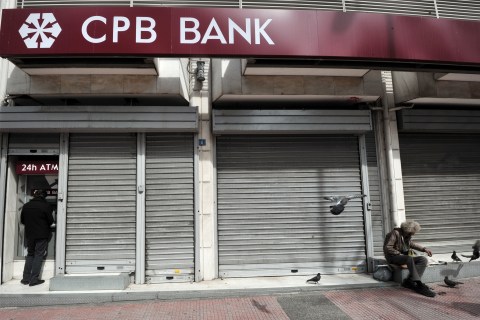
A man withdraws money at an ATM at a Cyprus Popular Bank branch in Athens on March 19, 2013
Is any country too small to save? Not if it is part of the E.U., according to officials who hammered out a bailout deal early Saturday for the tiny Mediterranean island of Cyprus, whose economy faces a collapse. In an exclusive interview with TIME last Thursday, on the eve of the Cyprus crisis meeting in Brussels, Christine Lagarde, managing director of the International Monetary Fund, stated that the deal “cannot be a Band-Aid.” Sitting in her office in Paris that night, she said, “It’s true it is tiny, the size of Limousin,” a small region of central France. “However nonmaterial that country is relative to others, it is nonetheless significant and potentially an exposure for the whole of the euro zone because of the links between the various systems,” she added. With Europe’s banks intricately connected across the continent, an economic meltdown in Cyprus — one of the E.U.’s smallest countries — has “contagion risks.”
Just how real those risks are has become clear in recent days. After holing up in Brussels through Friday night, Lagarde and the Finance Ministers of the 17 euro countries emerged early Saturday with a deal that forced regular citizens of Cyprus to shoulder $7.5 billion of the cost while the IMF and the E.U. would loan $13 billion of the total bailout. With Cyprus as the fifth country to seek an E.U. rescue, the deal was unique in imposing a one-time levy on all bank deposits, of 6.75% for accounts holding less than €100,000 ($130,000), and 9.9% for those above that figure.
Enraged at the prospect of losing their life’s savings, which they had assumed were safely tucked away, Cypriots stormed ATMs to withdraw their money, emptying out many of the machines. The country’s banks have all shut until Thursday. The fallout of the E.U. plan does not end with Cyprus, however. Billions of euros have been stashed in Cypriot banks by Russian investors, and President Vladimir Putin called the bank levy “unjust, unprofessional and dangerous.”
(MORE: Cyprus: The E.U. ‘Rescue’ That Risks Backfiring)
Although the stampede might have been foreseen, Lagarde insisted in her interview with TIME that Cyprus urgently needed to overhaul its banks, which were “massively overstretched.” Marketing themselves as safe havens for offshore investors — and with few questions asked about where the funds originate — Cypriot banks had amassed deposits roughly eight times the size of the country’s GDP. Those deposits have been at risk, in part because of the country’s close links to nearby Greece, which is one of the worst affected countries in Europe’s economic crisis. Lagarde said Cyprus’ banks were operating on “a business model that is probably not sustainable in the long term” and that the government needed “a sustainable solution with the appropriate financing.”
With Cyprus now in turmoil, Lagarde took that message to Frankfurt on Tuesday, telling an audience of about 150 mostly German bankers at the Frankfurt Finance Summit that Cypriot officials needed to “deliver on what they have committed.” Yet she struck a slightly more conciliatory note, saying that the IMF was “obviously extremely supportive of the Cypriot authorities’ intentions to introduce more progressive rates in the one-off levy.”
Confronting widespread rage over the plan, Cyprus’ President Nicos Anastasiades proposed that bank clients with less than €20,000 ($26,000) in savings be exempt from paying the levy. That, however, would require the richer investors — many of them Russians — to pay a greater percentage, a potentially explosive issue for the banks’ prized clients. Meanwhile, a series of Cypriot legislators took to the podium Tuesday to criticize the bailout plan, and it looks increasingly likely that parliament will reject the levy plan.
Either plan looks sure to infuriate many people. And yet, at the Frankfurt summit, one prospect seems far worse than the turmoil in any E.U. country: the exit of one of the 17 nations that have adopted the euro, which bankers believe would scare off investors from any troubled E.U. country. “If a single country leaves the euro zone, it sets a precedent,” said David Folkerts-Landau, chief economist of Deutsche Bank. “No one will ever again believe that a country will not leave the euro zone.”
MORE: Why the Better Business Bureau Should Give Itself a Bad Grade